
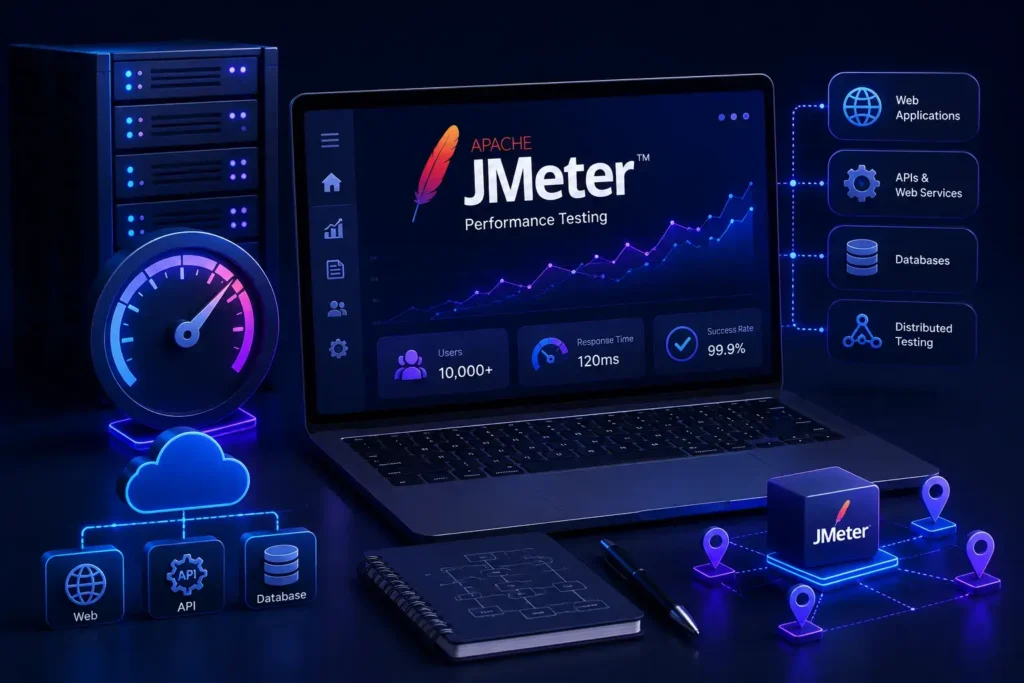
Performance testing has become an essential part of software development, and Apache JMeter continues to be one of the most trusted tools in the industry.
Originally designed for web application testing, JMeter has evolved into a powerful platform capable of testing APIs, databases, web services, and distributed applications.
Why Teams Choose Apache JMeter
Apache JMeter offers several advantages:
- Open-source and cost-effective
- Supports multiple protocols
- Highly extensible through plugins
- Strong community support
- Suitable for both small and enterprise-scale projects
Common Use Cases
API Performance Testing
Validate REST and SOAP API performance under varying loads.
Website Load Testing
Simulate thousands of concurrent users accessing web applications.
Database Testing
Measure database response times and transaction performance.
Distributed Testing
Generate large-scale traffic from multiple machines.
Challenges with Traditional JMeter Usage
While JMeter is powerful, organizations often face challenges such as:
- Manual test execution
- Limited centralized management
- Complex reporting
- Difficult collaboration among teams
The Next Step: Intelligent Performance Management
Modern organizations are extending JMeter capabilities with centralized platforms that provide automated execution, advanced analytics, monitoring, and AI-driven insights.
Conclusion
Apache JMeter remains a cornerstone of performance engineering. When combined with intelligent management platforms, it becomes an even more powerful solution for enterprise performance validation.